---
title: "Custom CSS"
description: "How Adminkeep's Custom CSS works: the Appearance screen, the live editor in the admin bar, what is refused, who can edit it, the REST API route and WP-CLI."
source: https://adminkeep.com/docs/custom-css/
---
Custom CSS gives your site one stylesheet that belongs to the site rather than to a theme. It
prints on whichever theme is active, so switching themes doesn't leave your tweaks behind. This
page is the reference; the [custom CSS plugin](/custom-css/) page has the overview, and
[why WordPress custom CSS disappears](/guides/wordpress-custom-css/) explains the problem it
solves.
## Turn it on
Go to **Settings → Adminkeep** and switch on **Custom CSS**, in the **Appearance** group. You
then have two places to edit the same CSS:
- **Appearance → Custom CSS**, a screen in the admin, next to
[Header & Footer Code](/docs/header-footer-code/).
- **Edit CSS** in the admin bar on your site, which opens the live editor over the page you are
looking at (since 2.1.0).
Both save to the same place, so use whichever suits the change.
## The Custom CSS screen
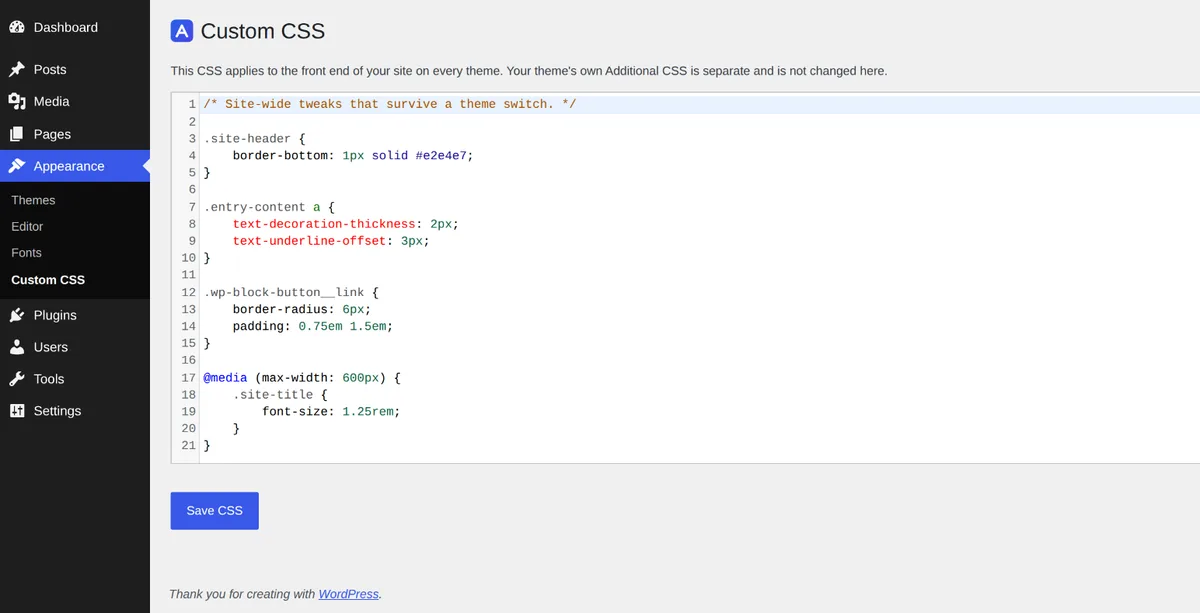
Appearance → Custom CSS, with the Live preview box that opens the live editor.
The editor is the one WordPress uses for its own CSS box: line numbers, syntax highlighting and
linting that flags mistakes as you type. If you have switched syntax highlighting off in your
profile, you get a plain text box instead.
Press **Save CSS**. Since 2.2.0 the screen saves without reloading: "CSS saved." appears under
the heading and the editor stays where you were. If the save is refused, the reason appears in
the same place and what you typed is left untouched. If your login has expired while the page
was open, the message says so: copy your CSS, reload the page, and save again.
The **Live preview** box beside the editor has an **Open live editor** button, which opens your
home page with the live editor already open.
## Edit on the live site
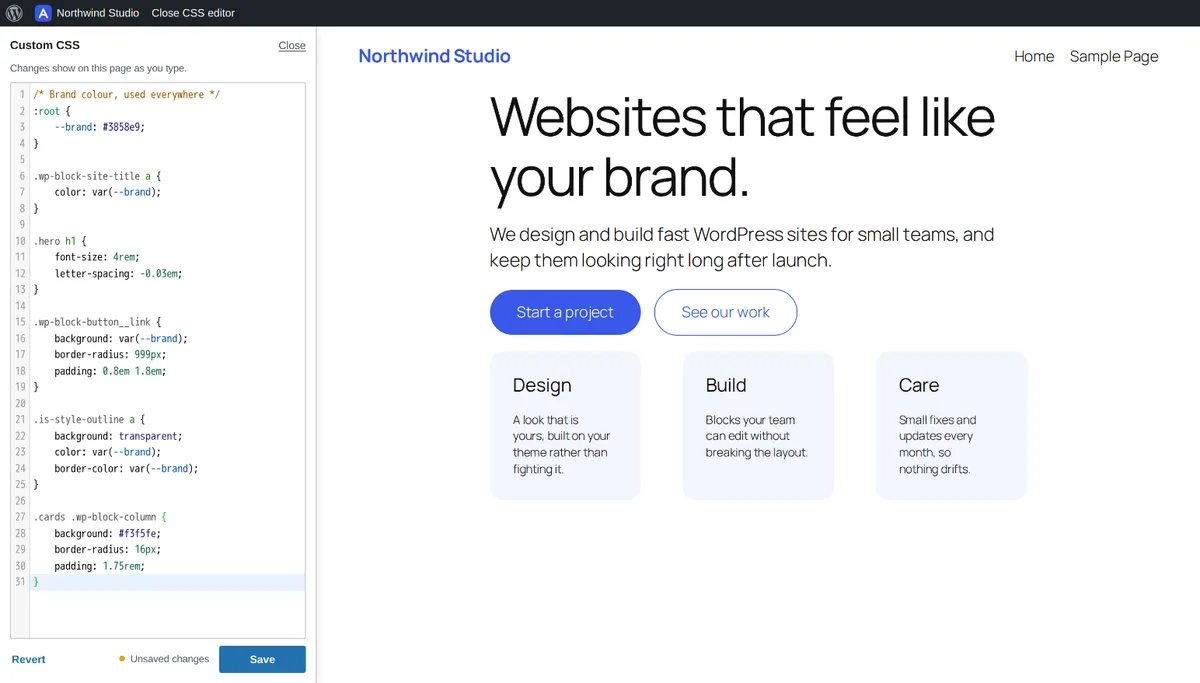
Edit CSS in the admin bar: the page restyles as you type, and nothing is saved until you press Save.
On any page of your site, click **Edit CSS** in the admin bar. The page reloads with a code panel
docked on the left, holding your stored CSS in the same code editor. On a narrow window the
panel becomes a sheet along the bottom of the screen instead.
- **The page restyles as you type.** A moment after you stop typing, the page you are looking at
picks up the new CSS. Only your browser sees it: visitors keep getting the saved CSS until you
press **Save**.
- **Save** (or Ctrl+S / Cmd+S) stores the CSS with the same checks as the screen. A dot and
"Unsaved changes" show while the panel holds edits you haven't saved.
- **Revert** puts the last saved CSS back in the panel, and the page with it.
- **The panel stays open while you browse.** Follow a link, submit a form or go back, and the
panel is still there, so you can check a change on other pages. Unsaved edits don't travel
with you: your browser asks before you leave a page that has them.
- **Close** in the panel, or **Close CSS editor** in the admin bar, ends editing. Logging out ends
it too, and so does closing the browser.
Ordinary page views load nothing extra: the editor and its script are only loaded on pages you
view while editing.
**On a phone,** WordPress hides most admin bar items, so Edit CSS isn't shown there. Use
**Appearance → Custom CSS → Open live editor** instead.
**Don't want Edit CSS in the admin bar?** Untick **Show Edit CSS in the admin bar** in the
Custom CSS settings (Settings → Adminkeep → Custom CSS). It is on by default. With it off, the
live editor still opens from the Custom CSS screen. From a shell:
`wp adminkeep feature set custom_css admin_bar=false`.
## What it prints, and where
The CSS is kept in a site option that belongs to Adminkeep, not to a theme, and printed in the
`` of every front-end page, on classic and block themes alike.
- **Your theme's Additional CSS is left alone.** Use both if you like. Adminkeep's CSS prints
after it, so when the two set the same property with equally specific selectors, Adminkeep's
rule wins.
- **Front end only.** It isn't loaded in the admin or in the block editor, which is why the live
editor works on the site itself.
- **An empty stylesheet prints nothing.**
## What is refused, and who can edit
**HTML is refused.** Anything that looks like an HTML tag is rejected when you save, from the
screen, the live editor, WP-CLI or the REST API, and nothing is written. A pasted snippet can't
slip a `